

Slow Down: A Dispatch from Molokai
What Local Government Can Learn from an Island That Said No

This is a travel post. Indulgent, yes, but also the opening of a series about a question I am still locating in myself. It goes something like this:
How can local government develop land in a way that sustains both the environment and the economy?
I am a naïve outsider, or haole, who arrived on Molokai, Hawaii, recently with a particular curiosity about why the island has been so fervent about stopping big business development and tourism.
Before accepting the invitation to visit, our hosts gently warned us: the only way to get to the island is by small plane, the closest gas and groceries are about 20 miles away, don’t bring anything white unless you don’t mind that it will never be white again, everything is expensive and hiking sandals with heavy soles are helpful to avoid the toxic thorns of the invasive Kiawe…
According to Wade Graham, in his provocative book Braided Waters, Molokai has been known as a place of failure and exile. A history of extensive environmental and societal damage has occurred from repeated attempts to develop big agribusiness such as pineapple, coffee, cattle.
The question of why these efforts failed and have had negative impacts on society and environment is a deep question that I am still turning over in my own mind. My notes here are an attempt to process why these outcomes have occurred in such a rare place of beauty and how the story of Molokai is also the story of many other places around the world.
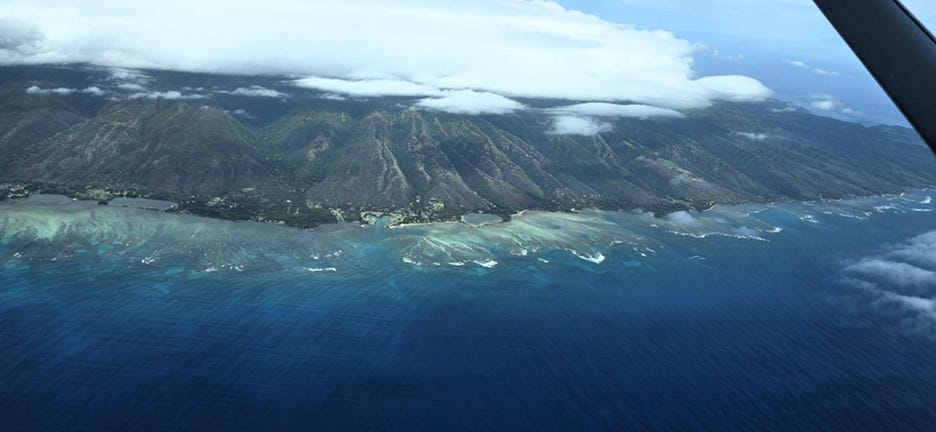
[East end of Molokai, from our plane. Note the intact reef apron that frames the coastline. There is one two lane road that follows the edge of the island. Travel is slow but you see locals pulled over to the side of the roads and encampments that conjure up community gathering. Note too the ridges and crevices that result from the early volcanic formations of the island. Photo by njhess]
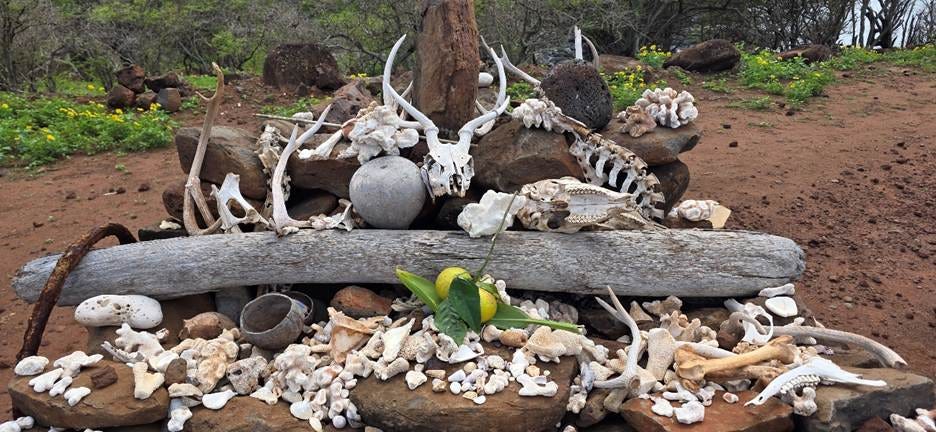
[This may be an example Mālama Pū‘olo, the caring for and keeping of sacred items. Arrangements like this were found on hikes. Photo by njhess]
Features of the terrain make it difficult to penetrate on the east end, the windward side that features a wet climate known in the tropics. The west end, or the leeward side of the island is arid and relatively level, therefore more amenable to development. The Polynesians were well adapted to both conditions since their arrival somewhere around 1000 AD. When the outsiders began to arrive sometime around 1778, the natural assets held great promise for capitalist gains.
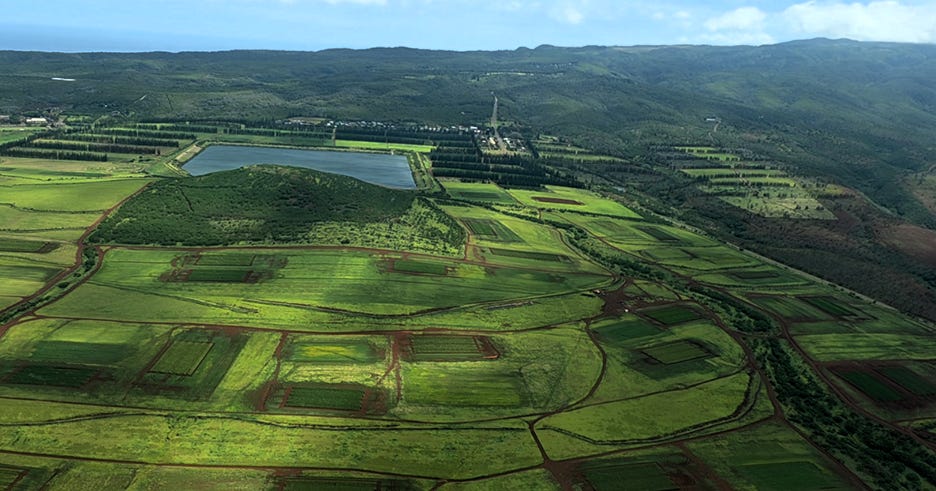
[This area of Molokai, close to the center, was taken shortly after takeoff. Notice the beauty of the smallness of the farms, also the rich red soil that outlines the properties. Photo by njhess]
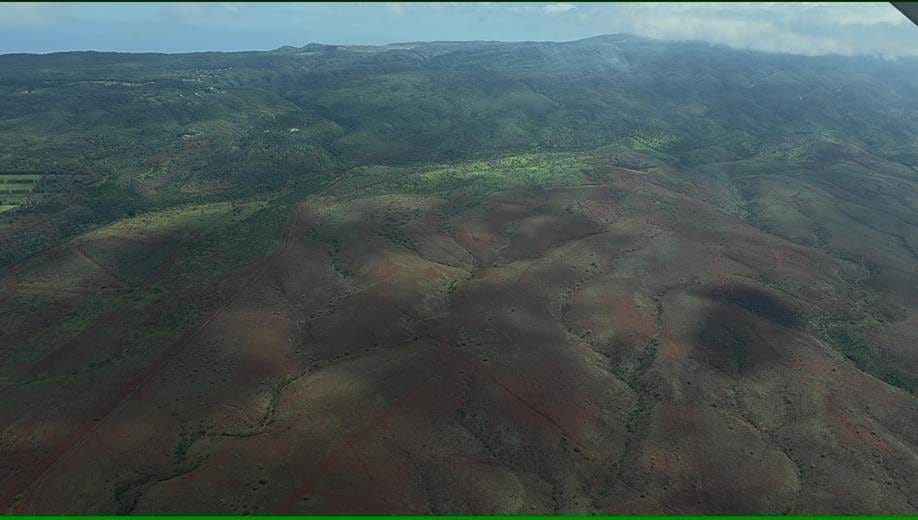
[The west end of Molokai captures the arid terrain that defines the leeward side of islands that are prone to wind and less rain. Photo by njhess]
Graham suggests that the people of Molokai, from the earliest days of invading armies, were thought to be easy to subjugate but not receptive to any social or economic order forced upon them.
When I look at the verdant green, undeniable productivity of these farms, I find myself thinking about how we define state capacity and what metrics we choose to measure economic prosperity. Perhaps big tourism and industrial agricultural enterprises reap major profits for other islands, but can they mirror the pride and beauty of small farms that serve collective local interests?
I make this point only to put a pin in this question:
To what extent does the global prosperity of other Hawaiian Islands impact the affordability and ease of small development for the people on Molokai? In other words, in what ways are subsistence economies built by small businesses eaten up by big economies that dominate, even if it is the next island over or, fill in the blank, the next community over from where you live?
This is a question I will revisit through this series.
One of the sites that Molokai is most famous for is Kalaupapa, a quarantined colony established in 1866 for Hansen’s disease (also known as leprosy) largely attributed to exposure to the disease from outsiders. Father Damien, who oversaw the settlement, started a school and numerous churches on the island, eventually succumbed to leprosy himself in 1889 at the age of 49. Although the quarantine ended in 1969, there are still survivors and the location is largely closed off to the public and will remain so until all the inhabitants pass. The story about this place is dramatic and has been told by many so I will not try to do so myself, but it is an important part of Molokai history that has placed it at the margins of Hawaiian state making.
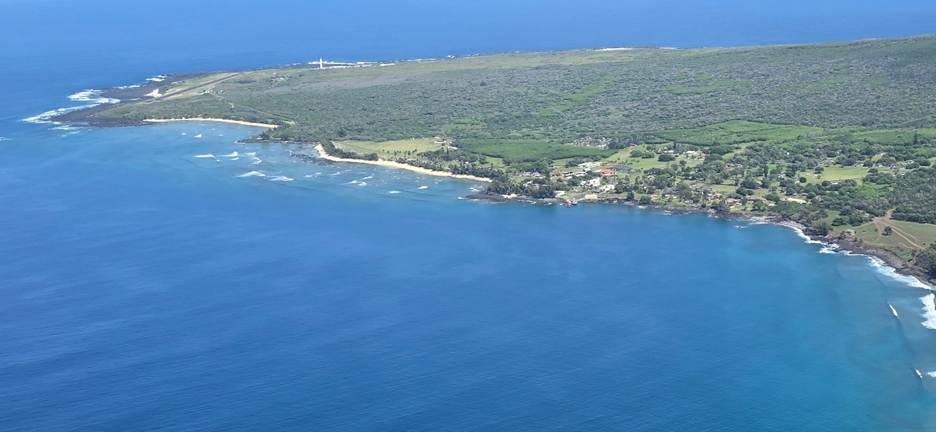
[Site of Kalaupapa photo by njhess]
Our hosts are geologists who split their time between Alaska and Hawaii, so they not only understand the unique relationship between indigenous people and land but also the value of the natural resources that can drive economic prosperity. We hiked in various parts of the island that displayed the full potential of natural resources as well as the dismal degradation left from failed efforts to bring about prosperity.
In fact, Wade Graham centers Braided Waters on the centrality of water to the struggles for sovereignty and control of resources on the island.
To an outsider, it can be hard to comprehend why an island would not desire development of infrastructure to spur economic prosperity, but the story is more complex than one might imagine. It begins with understanding the place as a complex and fragile system that can be easily thrown out of balance by big intentions.
So, a few things began to come together from my reading and observations.
1. In Hawaii, we see the depth and breadth of the issues that arise from the wants and needs of community versus those of corporate interests.
2. Molokai has a long prior history of domination by public/private interests and mistrust as a result of things gone wrong.
3. Efforts to repair, reconcile and renew economic initiatives have been met by fierce resistance that have frustrated many, but also fueled activism.
4. The remoteness of the islands has not been well understood in the context of environmental degradation. When big business agricultural “experiments” go wrong, you lose native plant and wildlife. The unique environments in Hawaii took millennia to develop and the extreme remoteness does not lend itself to easy replenishment.
5. Indeed, Hawaii was thought of as a petri dish for agricultural experiments without thought for the long term impact on the environment.
In that context, and this is a simplified summary, one might understand the activist point of view. In my conversations with locals, I heard versions of the same message, “we prefer a simple life here.”
When I arrived on Molokai, my fellow passengers said, almost in unison, “Okay, now it is time to slow down.” In effect, do not expect the fast pace of life found on other islands. However, some of them were clearly returning from shopping on Maui!
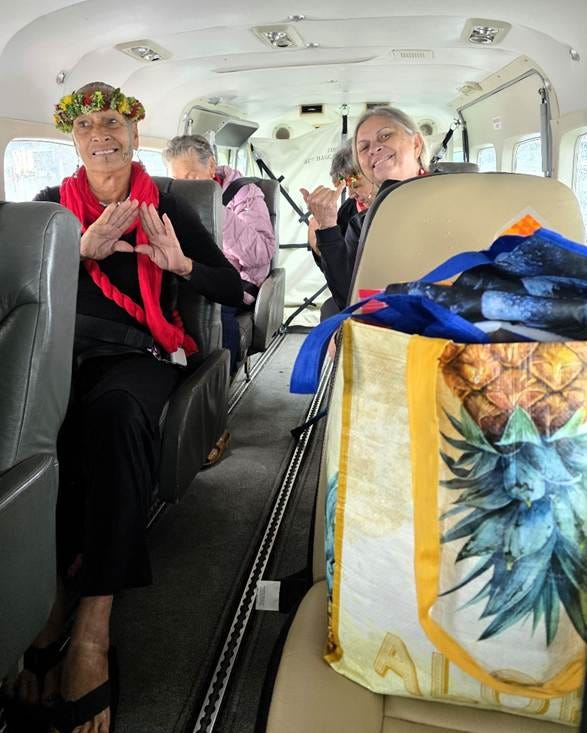
[“Slow down!” My fellow passengers on Mokulele Airlines ]
Locals work hard, some told me they work three jobs to make ends meet. But they prefer work that is central to feeding their family, like hunting, fishing, bartering crops; selling items to others or running a small food market stand or truck.
What they are against is working for low wages at a company that sends profits someplace else.
You might wonder, what is wrong with a small luxury resort on the corner of the island? Think of the jobs and the money that would come to the island. The response of the activists is that once in, a few rich people will take over boards and commissions and open the door to more extended development all over the island.
Of course, Hawaii is no different from local governments anywhere else. If someone wants to sell their property to a wealthy person able to pay a premium price for an ocean view, then there is nothing to be done.
But on this island, you will see undeveloped properties because permits are hard to get and the general scarcity of highly skilled labor and lack of infrastructure discourages progress.
One of my clearest takeaways from the island was the visible impact of activists on development. We often say that once a zoning map is in place, what can you do? How can you resist or stop unwanted development?
The people of Molokai are adept at constant and unrelenting activism. You see it in what is not built.
While there are pockets of small developments and concerned citizens who wish to develop economic initiatives, the operative word is small.
This idea speaks to the Hawaiian philosophy of Kilo which means observing and studying the natural world to understand the patterns and relationship that govern it. That takes time. Big business does not meet this criteria.
Our best meal was from a food truck. The fruits, vegetables, fish and beef available on the island are incomparable to what we find on the mainland. Why? Because it is all local.
However, if you type in “Molokai” on Trip Advisor, you will likely see reviews of rundown island resorts. Our hosts live in a lovely small condominium community that sits adjacent to an abandoned condo community. The effect is dystopian and any visitor who is lured to Molokai with the pretense that it is a cheaper version of Maui will be sadly disappointed.
In fact, one of the most significant failures involves Molokai Ranch in the West End. It is the largest landholding by a private enterprise (~55,000 acres). The story of Ranch is beyond the scope of this short introduction to Molokai, but suffice it to say the development has been met with significant resistance and much of the landholding stands in limbo.
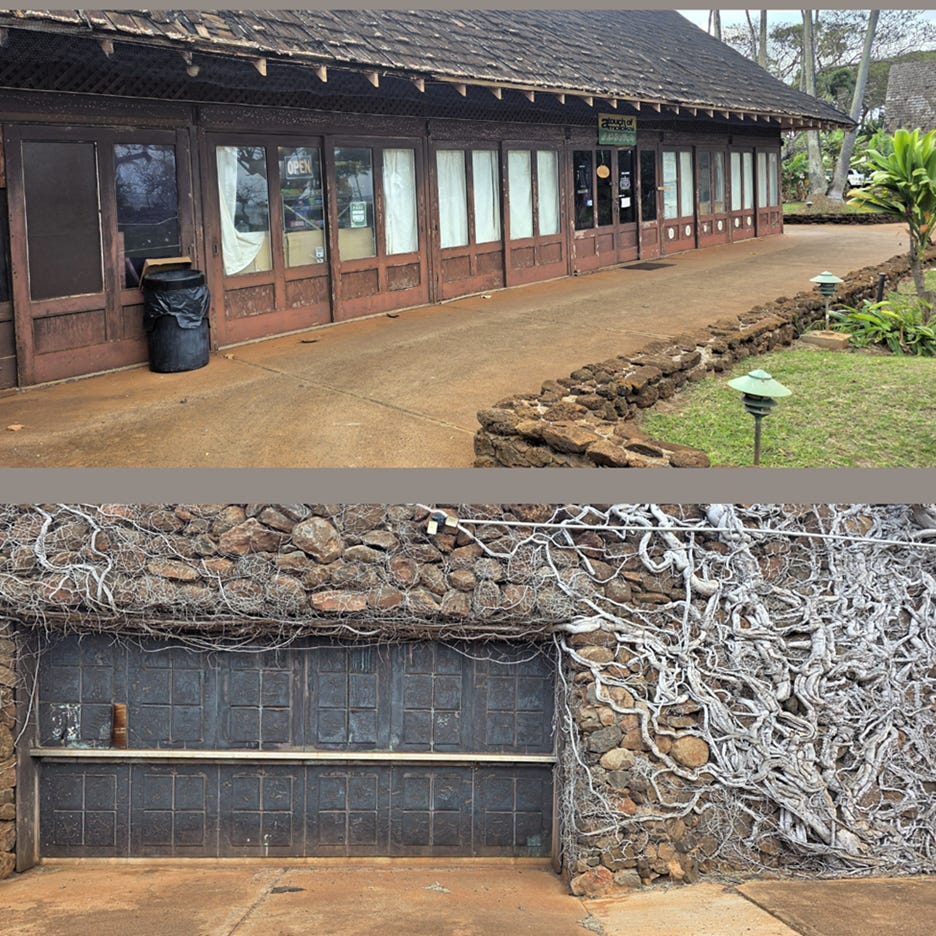
[Vestiges of the failed Molokai Ranch project. Photo by njhess.]
It is hard to express in words how much the lack of development has impacted the island. From the curious mind of an outsider, you will see abandoned efforts such as golf course paths that go nowhere, resort-like structures that have been abandoned and will be costly to re-develop.
However, if you want to see what sustainability looks like, there is plenty to learn from Molokai. You will meet people who fish to eat, who practice self-reliance alongside communal bartering and local market economies. This is where the real lessons of Molokai can be found.
This subsistence way of life is in full view to the visitor.
Here is what I began to notice about sustainability as it relates to local governments (and bears more attention):
1. Economic development dominated by one industry means that the whole community suffers when that industry falters or simply disappears.
2. Tourism has the potential to drive the cost of living up. Profits will benefit the corporate offices usually located out of state while depressing wages.
3. Hawaii has a history of immigrant labor willing to work for low wages and long hours. Hawaiians prefer a subsistence lifestyle that allows them to do what they love for however many hours it takes to meet the needs of the family.
The white settler endeavors to have his work done by Orientals. He tries to secure a larger piece of land than he could cultivate himself and to work it by cheap labor rather than take the small area and intelligently till it by his personal efforts. (Commissioner Frederick Newell, to the U.S. Congress Federal Bureau of Reclamation, 1909; Braided Waters, p.138)
These tensions play out today in Molokai and I can’t help but see echoes of this same tension in many local governments.
Big business and government policy shape a political economy; politics affects the economy and the economy in turn shapes the politics.
Re-engineering water and forests are seen as part of the broader social evolution of the Hawaiian Islands. Decline of trees and native peoples are seen as part of the same evolution due to the impact of a political economy.
This is a central message of a famous activist Walter Ritte, who fought the smallest luxury development because the smallest incursion of excessive wealth, in his mind, would open the door to greed and a small number of elites who would eventually control the economy of the island.
He echoes a Hawaiian philosophy of Kuleana which is the responsibility of each individual to care for the land, community, and resources.
“Take only what you need” is a common expression that reflects that philosophy. Corporate interests that express greed are contradictory to this belief system.
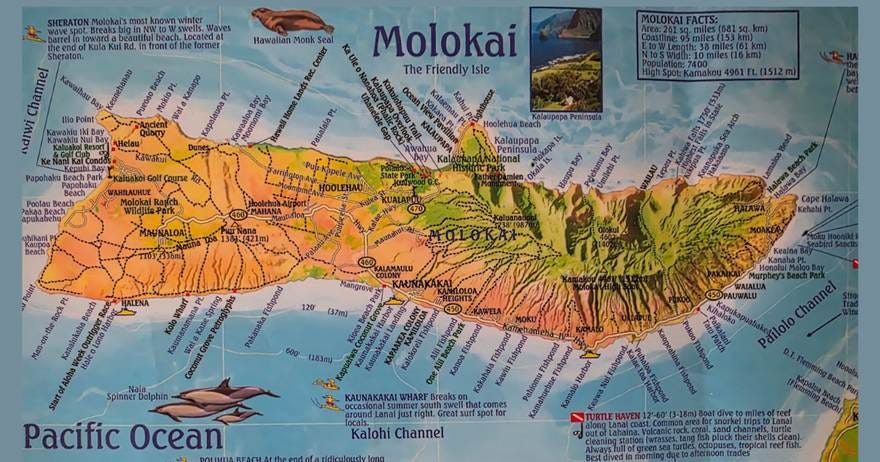
[A popular map of Molokai is one of the remnants of a more inspired time when tourism and luxury resorts were in the works. It is a reminder of the dream of a more developed island not so long ago. Hotels, wildlife parks, golf courses, among many other sites depicted on the map are simply non-existent.]
Observing Molokai, it was hard not to think about our own local governments. In what ways are elements of subsistence evident in our own local economies? Common lands for hunting and fishing might be one example. Thriving local markets another.
Do we pit economic development against the health of natural community systems, or do we work through the difficulties of balancing interests?
If we begin with the assumption that we desire economic development and have a willingness to exploit resources for the right gains, where does that take us? Certainly, it is a difficult but worthwhile and necessary debate.
History bears truth to both sides. A quote describing one example of a failed business venture that faced community opposition:
“The misunderstanding and mistrust….was a manifestation of a long standing tension between the people of the East End, engaged in their ohana-based, partly subsistence lifestyle, and the West End, generally in the form of the Molokai ranch, perceived as haole outsiders bringing an unwelcome capitalist system that would reduce the Hawaiians to plantation peonage….to some extent this resentment has remained alive in the background of Molokai life ever since and survives to this day.” (Braided Waters, p.166)
Expressions of NIMBY (Not-in-my-backyard) reflect similar attitudes. We don’t like changes to our the way of life, particularly when change opens the door to unwanted development. “Yes, we want jobs, but build that structure someplace else!”
What I observed on Molokai was an attitude that suggests an awareness of the value of what they have and what they do not want from outsiders. Although I did not experience any unfriendliness, quite the opposite, the stories that were told to me by locals about their experience of living on other islands or on the mainland were told to emphasize why they prefer their native values and attitudes.
For example, I spent some time talking to Chanty one afternoon at the beach and she told me that since she was visiting ‘ohana, or extended family, she thought she should take some fish (she was there with her spear gun). This is not just a common courtesy when visiting family. It is not a transaction, this is a practice and way of life. She had plenty to say about the difficult relations in her family system, but this did not alter her desire to show respect for tradition.
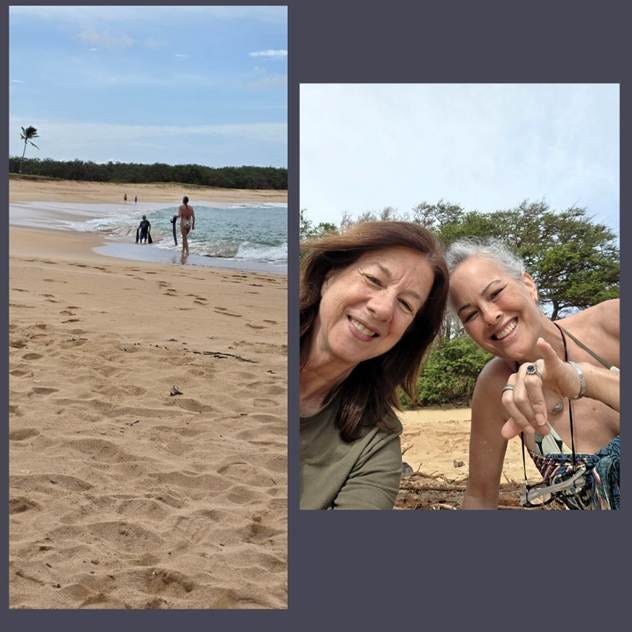
[Chanty (right) taking time out of her fishing to tell me about her life.]
Hawaiians practice Aloha ʻāina which refers to love and stewardship of the land. This is the spiritual foundation of their activism but also reflects values shared by people around the world.
I am in the process of developing a series of writings on The Art of Not Being Governed, by James C Scott. His writing emphasizes the importance of equality, autonomy and mobility among peoples that prefer to not be “captured” by political economies that dictate industry, work and wages.
Subsistence-hybrid economies are vulnerable to outsider interests and disruptions. One aspect of the island I have not mentioned is the extensive reliance on government assistance. Molokai is part of Maui County and enjoys a good health care system as well as subsidized housing for indigent people.
We can at least muse whether the severe disruption by big business ventures in earlier phases of Molokai life or even the dominance of industries in nearby islands of Maui and Oahu contribute to welfare dependency.
Plenty of evidence exists that the island previously used what was known as the Kohela Field System (1450 – 1800) to feed 20,000 – 30,000 people. This history defies the colonial narrative of Hawaii as small and primitive. (Jamie Helmick, Ulu,Ulu; 2024)
Today the population of Molokai hovers just over 7000. Could depopulation of the island and degradation of natural resources be viewed as directly linked to misguided development?
I am not as interested in forming opinions as I am the right questions.
On a whale watching excursion, I shared a bean bag on the bow with two Hawaiian divers onboard that were there to help us move around the boat when the waves got rough. They sat close, asked if I needed a jacket, and protected me from the heavy spray of sea water coming up over the bow. I was limping from injuries incurred while kayaking the previous day and took their kindness as a natural courtesy.
I asked them a question that had been weighing on my mind. “Do you see many sharks on your diving expeditions?” They answered, “oh yes, all the time!” (With enthusiasm I might add.) I said, “well, isn’t that scary?” And they said, “oh no, not at all. On Molokai, the reef is so rich the sharks have plenty of food. They are quite uninterested. But if you go to Oahu, there is very little left of the reef. If you dive there, you must recognize that you are the competition. So you are more likely to engage with a shark!”
To me, this story sums up the point of my writing. Our relationship with sharks is a metaphor for how local economies interact with global capitalism. Sharks are like local businesses that sustain a place. I might even stretch that metaphor to say they guard the sovereignty of place; but when global companies gobble up the market, local businesses and people become aggressive to protect their way of life before it is diminished or eliminated altogether.
My visit to Molokai arrived at exactly the right moment. In 2025 I began a series of writings on the work of James C. Scott (Seeing Like a State, The Art of Not Being Governed and In Praise of Floods) His work first introduced me to the themes that came alive for me in Molokai. Going forward in MuniSquare, we will discuss what makes people resist being governed, and what resistance looks like.
I could not have begun to understand the link between James C. Scott’s ideas and the people of Molokai without the writing of Wade Graham (Braided Waters). Although he writes from a different vantage point, he is equally provocative in challenging our traditional thinking about how society and environment interact to shape culture.
If we are to take the role of local government seriously, we must study and observe the people and places on this earth that strive with earnestness and courage to protect the values, ethics and norms that place life above profits.
Molokai is a story in process. I will share a few pictures that fueled my imagination and awe of a place that is rare to experience in the United States.
A few more pictures:
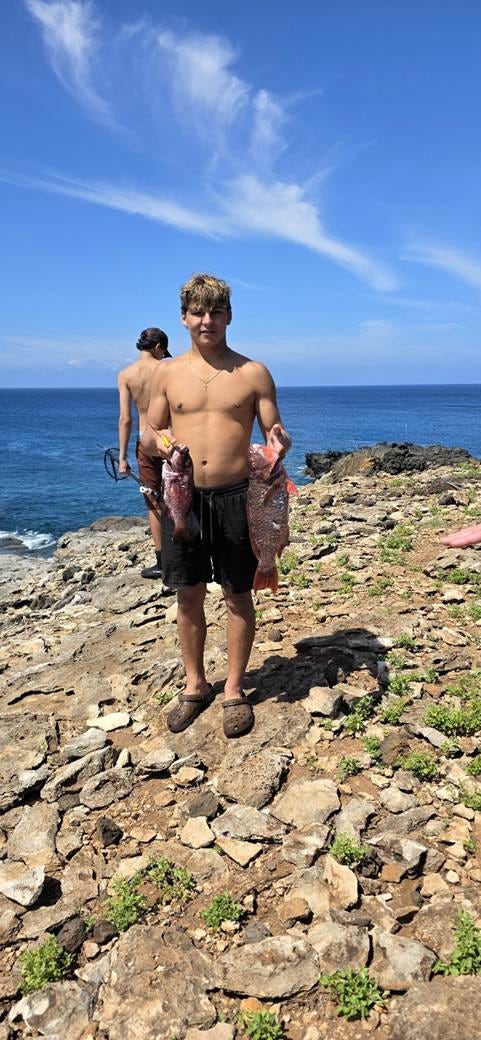
[Another spear fisherman. He told us he dove 30 ft down and held his breath for 90 seconds to make the catch. Also, no gear.]
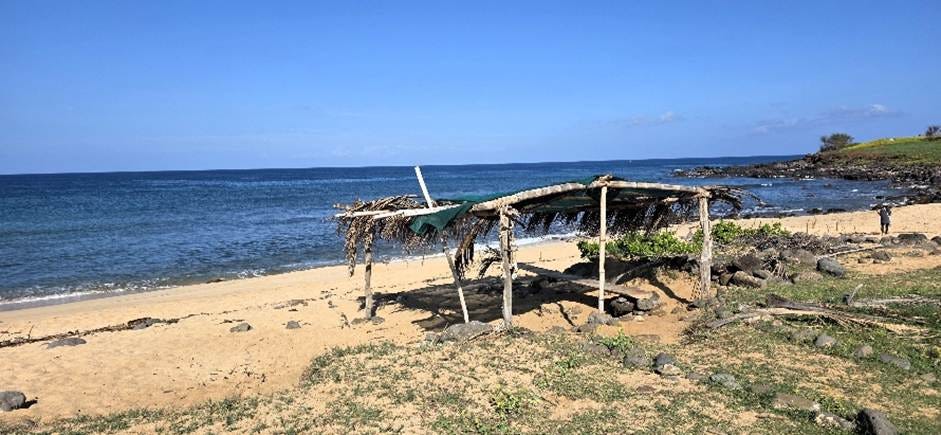
[Hale hālāwai- an informal gathering place. Photo by njhess]
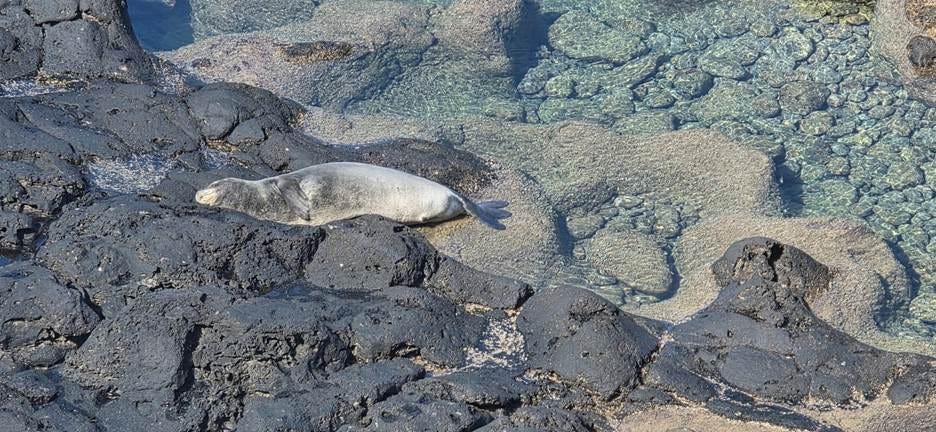
[Although we saw plenty of marine life, nothing moved me as much as the monk seals that found resting places along the shore. Many of them are females in labor just taking a rest. Photo and video by njhess]
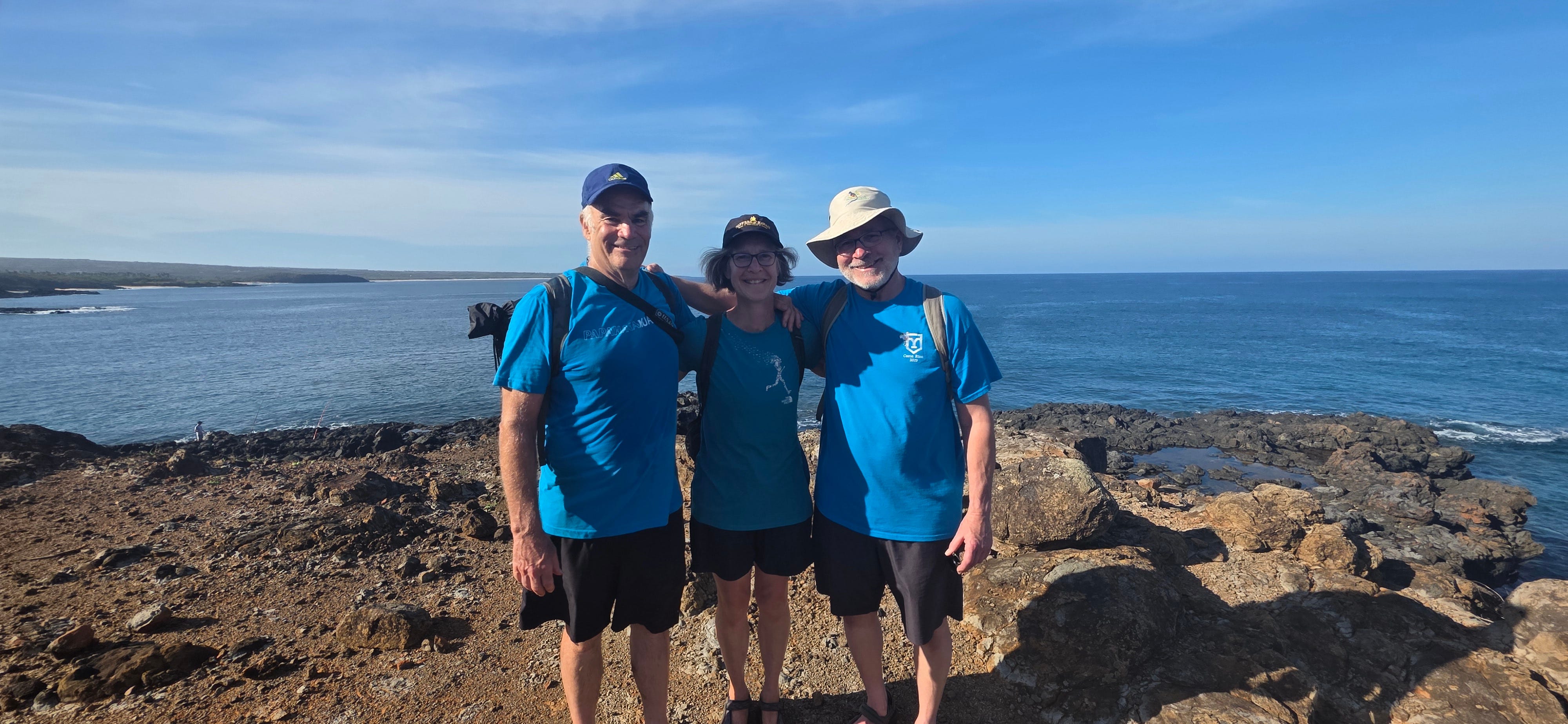
[Our intrepid hosts and my fellow traveller on a hike that took us over miles of volcanic rock and beach.]
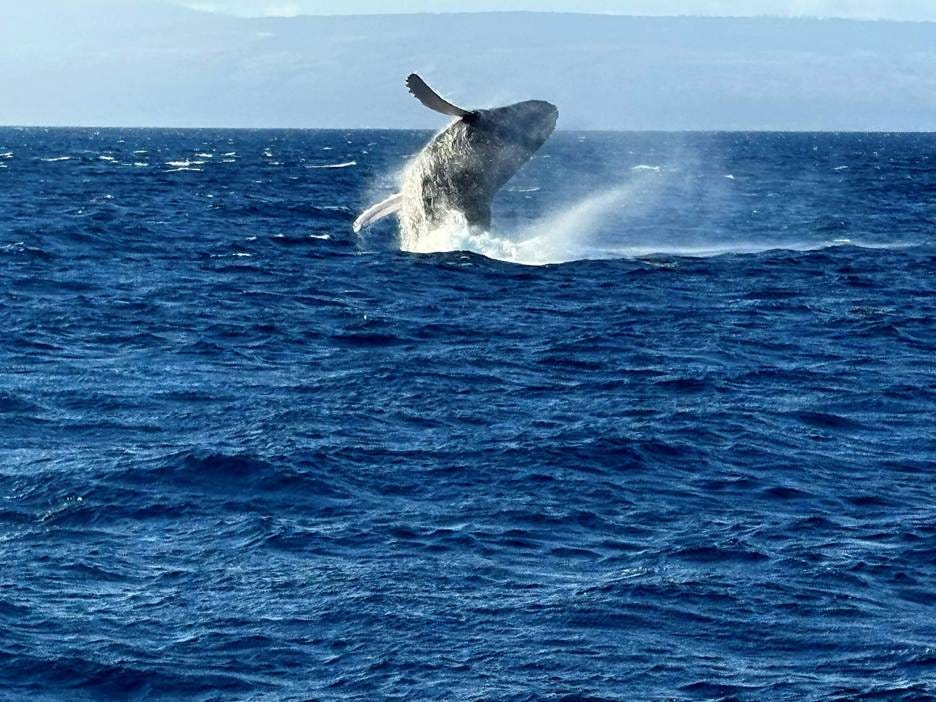
[Male whale breaching following a brilliant display of momma training baby whale. Just a signal to let us know who was in charge. These whales travel from Alaska to these specific waters near Molokai to give birth. Photo by watching mate who generously shared her “catch”.]